Steel & Iron Prices in Zambia
Compare prices for reinforcement bars (rebar), BRC mesh, and structural steel in Zambia. Steel prices track international commodity markets — fluctuations of 10-15% between quarters are common.
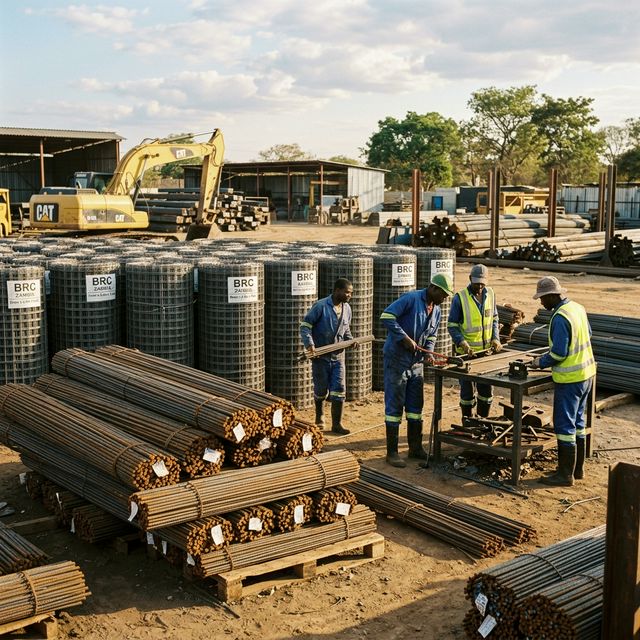
Rebar, BRC mesh, and structural steel for Zambian construction
Steel prices in Zambia rose 10-12% in 2025 due to Kwacha depreciation and higher global steel benchmarks. The World Steel Association projects flat global demand in 2025 with a modest 1.3% rebound in 2026 — Zambia's local market is growing faster at ~12.6% annually driven by infrastructure projects.
Steel Price List (Per Piece)
Reinforcement Bar Y10 (12m)
Y10 (10mm) · 12 metres · Deformed bar
ZMK 100 – 130
per piece
Used for: Slabs, lintels, ring beams
Reinforcement Bar Y12 (12m)
Y12 (12mm) · 12 metres · Deformed bar
ZMK 140 – 180
per piece
Used for: Columns, beams, foundations
Reinforcement Bar Y16 (12m)
Y16 (16mm) · 12 metres · Deformed bar
ZMK 230 – 300
per piece
Used for: Heavy structural work, deep foundations
Reinforcement Bar Y20 (12m)
Y20 (20mm) · 12 metres · Deformed bar
ZMK 380 – 450
per piece
Used for: Large columns, commercial foundations
BRC Mesh Ref 193 (2.4m × 5m)
Welded wire mesh · 2.4m × 5m · Ref 193
ZMK 350 – 500
per piece
Used for: Floor slabs, driveways, retaining walls
BRC Mesh Ref 395 (2.4m × 5m)
Heavy duty · 2.4m × 5m · Ref 395
ZMK 600 – 800
per piece
Used for: Commercial slabs, parking areas
Binding Wire (2.5kg roll)
Soft black annealed · 2.5kg roll
ZMK 60 – 80
per piece
Used for: Tying reinforcement bars together
Square Tube 25mm (6m)
Mild steel · 25×25mm · 6 metres
ZMK 120 – 160
per piece
Used for: Window frames, burglar bars, gates
Angle Iron 40mm (6m)
Mild steel · 40×40×3mm · 6 metres
ZMK 100 – 150
per piece
Used for: Door frames, structural supports, fencing
Understanding Rebar Grades and Standards
Reinforcement steel in Zambia is manufactured primarily by Kafue Steel (Universal Mining & Chemical Industries Ltd — UMCIL) under the UMZ brand. Their TMT (Thermo-Mechanically Treated) bars comply with BS 4449:2005 Grade 500B — the same standard used in the UK and most Commonwealth countries. Imported rebar comes mainly from South Africa (Arcelor Mittal, Cape Gate) and China.
The "Y" prefix indicates high-yield deformed bar (Grade 500). The number is the diameter in millimetres. Deformed bars have ribs that grip concrete better than smooth (round) bars. For structural work, only deformed (Y) bars should be used — smooth bars are limited to ties, stirrups, and non-structural elements.
Steel Requirements for Common Projects
Typical Steel Quantities
3-Bed House (120m²)
3 – 5 tonnes rebar
Foundation, columns, beams, slab
Driveway (50m²)
4 – 6 BRC mesh sheets
Ref 193 or Ref 395
Boundary Wall (50m)
0.5 – 1 tonne rebar
Y10 for piers, Y12 for foundation
These are rough estimates — always obtain a structural engineer's Bill of Quantities (BoQ) before purchasing steel. The BoQ specifies exact bar sizes, lengths, cut schedules, and quantities for every structural element. A structural engineer's fee (ZMK 3,000–10,000 for a residential house) pays for itself by preventing over-ordering or dangerous under-specification.
Buying Steel — Where and How
Factory-direct from Kafue Steel (UMCIL) offers the best prices for orders of 1 tonne or more. Their factory is located in Kafue town, about 45 km south of Lusaka. They produce rebar from Y8 to Y32 in standard 12-metre lengths. Ask for their current price list — it changes monthly based on scrap steel costs and international benchmarks.
For smaller quantities, Trade Kings Steel, Steel Masters, and hardware wholesalers in Lusaka Industrial Area (along Lumumba Road) sell by the piece. Retail hardware stores like Buildmart and Build It stock common sizes but at 15-25% markup over wholesale.
Buying tips: (1) Order all steel at once to get bulk pricing. (2) Verify the weight — a genuine Y12 bar (12m) weighs approximately 10.7kg. If it's significantly lighter, the bar may be undersized. (3) Store steel off the ground on wooden pallets and cover with tarpaulin — surface rust doesn't affect strength, but heavy corrosion does.
Steel Buying Questions
How much steel rebar do I need for a 3-bedroom house in Zambia?
A typical 3-bedroom house (120m² floor area) requires approximately 3-5 tonnes of reinforcement steel. This includes rebar for the foundation (strip footings or raft slab), ring beam, lintel beams, columns, and roof slab (if applicable). The exact quantity depends on the structural design — always get a structural engineer's Bill of Quantities before purchasing. Buying based on guesswork either wastes money (over-ordering) or compromises safety (under-ordering).
What is the difference between Y10, Y12, and Y16 rebar?
The number indicates the bar diameter in millimetres. Y10 (10mm) is used for lightweight elements: slab reinforcement, lintels, and ring beams. Y12 (12mm) is the standard for columns and beams in residential construction. Y16 (16mm) is used for heavy structural work: deep foundations, large columns, and commercial buildings. The letter "Y" indicates a high-yield deformed bar (Grade 500B), which has better concrete bonding than smooth (mild steel) bars.
How can I tell if rebar is genuine quality?
Look for: (1) Clear mill markings stamped on the bar showing the manufacturer and grade (e.g., "UMZ 500" for Kafue Steel products). (2) Consistent deformation pattern — ribs should be uniform and evenly spaced. (3) The bar should not bend easily by hand at 10mm or above. (4) Ask for a test certificate from the supplier showing tensile strength and yield point. Substandard rebar is a serious safety risk — buildings have collapsed in Africa due to counterfeit steel.
Where can I buy steel rebar in Zambia?
Major sources: Kafue Steel / UMCIL (factory-direct, Kafue town — UMZ brand, BS 4449:2005 Grade 500B compliant), Trade Kings Steel, and various hardware wholesalers in Lusaka Industrial Area. Factory prices are 10-20% cheaper for bulk orders (1+ tonne). Retail hardware stores like Buildmart and Build It sell smaller quantities at retail markup. Always compare prices — steel fluctuates with international commodity markets.