Brick & Block Prices in Zambia
Compare prices for common bricks, concrete blocks, and specialty walling materials. Plus: how many you need for a 3-bed house, quality testing tips, and where to buy cheapest.
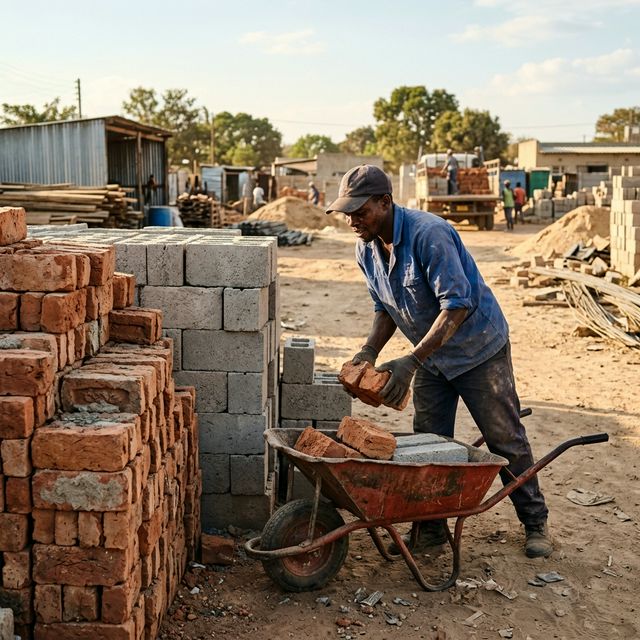
Burnt bricks and concrete blocks — Zambia's primary walling materials
Price Comparison (Per Piece)
Common Burnt Brick
Standard ~220×105×70mm · Hand-moulded · Kiln-fired
ZMK 3 – 4.50
per piece
Concrete Block 6" (150mm)
150mm × 200mm × 400mm · Solid concrete
ZMK 7 – 9
per piece
Concrete Block 8" (200mm)
200mm × 200mm × 400mm · Solid concrete
ZMK 9 – 12
per piece
Hollow Block 8" (200mm)
200mm × 200mm × 400mm · Hollow core
ZMK 7 – 10
per piece
Face Brick (Chimney Red)
Machine-pressed · 222×106×73mm · Red/brown
ZMK 6 – 9
per piece
Interlocking Block (CSEB)
Compressed stabilised earth · 300×150×100mm
ZMK 5 – 8
per piece
How Many Bricks or Blocks Do You Need?
Quick Quantity Estimates
3-Bed House (120m²)
15,000 – 20,000 bricks
or 3,000 – 4,000 blocks
Boundary Wall (50m × 1.8m)
5,000 – 7,000 bricks
or 1,100 – 1,400 blocks
Single Room (4m × 4m)
3,000 – 4,000 bricks
or 600 – 800 blocks
Rule of thumb: For common bricks (standard bond), budget approximately 55-60 bricks per square metre of wall area (single-skin) or 110-120 bricks/m² for double-skin. For concrete blocks (200mm), budget 12.5 blocks per square metre. Always add 5-10% for breakage and cutting.
Bricks vs Blocks — Which Should You Use?
🧱 Burnt Bricks (ZMK 3 – 4.50 each)
- ✅ Cheaper per unit — good for tight budgets
- ✅ Excellent thermal mass — keeps houses cool
- ✅ Traditional & durable — proven over centuries
- ❌ Slow to lay (5x more units per wall)
- ❌ More mortar needed — increases cement costs
- ❌ Quality varies wildly between kilns
⬜ Concrete Blocks (ZMK 7 – 12 each)
- ✅ Much faster to build — saves 30-40% labour
- ✅ Uniform size — cleaner walls, less plaster
- ✅ Stronger in compression — better for multi-storey
- ❌ Higher unit cost — but fewer units needed
- ❌ Can crack if foundation moves
- ❌ Less thermal mass than bricks
Quality Testing — How to Spot Bad Bricks
Tap test: A well-fired brick makes a clear ringing sound when two bricks are tapped together. A dull thud means under-fired — the brick will absorb water and crumble over time.
Scratch test: Scratch the brick surface with a fingernail. If it leaves a mark, the brick is too soft for structural use.
Water absorption: Soak a brick in water for 24 hours. It should not absorb more than 20% of its weight. Over-absorptive bricks weaken walls and cause damp problems.
Block test: A good concrete block should not break when dropped from waist height onto hard ground. Blocks that shatter on impact have insufficient cement content (some makers under-dose cement to cut costs).
Builder's Questions
How many bricks do I need to build a 3-bedroom house?
A standard 3-bedroom house (approximately 120m² under roof) requires 15,000–20,000 common burnt bricks OR 3,000–4,000 concrete blocks. The exact quantity depends on wall height (standard 2.7m), window/door openings, and whether you're using single or double-skin walls. Ask your builder for a Bill of Quantities — over-ordering by 5-10% is standard to allow for breakage and cutting.
Are bricks or blocks cheaper in Zambia?
Bricks are cheaper per unit (ZMK 3-4.50 vs ZMK 7-12 for blocks), but you need 4-5x more bricks than blocks for the same wall area. In total cost: a block wall costs roughly the same or slightly more than a brick wall, BUT blocks are significantly faster to lay (fewer units, larger size), saving 30-40% on labour costs. For most projects, concrete blocks are more cost-effective overall.
What is the difference between solid and hollow blocks?
Solid concrete blocks (8" at ZMK 9-12) are stronger and used for load-bearing walls — they support roof and upper-floor weight. Hollow blocks (8" at ZMK 7-10) have open cores that reduce weight and cost. They're suitable for partition walls, boundary walls, and non-structural applications. You can fill hollow blocks with concrete and rebar for reinforced columns — a common technique in Zambian construction.
Where can I buy bricks cheaply in Lusaka?
The cheapest source is direct from brick-makers in peri-urban areas — Makeni, Chilanga Road, and Great East Road have numerous small-scale brick kilns charging ZMK 2.50-3.50 per brick. For concrete blocks, block-making yards along Cairo Road South and in Industrial Area offer wholesale rates from ZMK 6-8 per block. Always test quality: a good brick rings when tapped, and a good block doesn't crumble when dropped from waist height.